ICSE vs CBSE: Key Differences, Benefits, and Which Board to Choose
Choosing between the CBSE (Central Board of Secondary Education) and ICSE (Indian Certificate of Secondary Education) depends on your child’s learning style, future career goals, and family mobility. Understanding ICSE vs CBSE can help parents compare their specific benefits for students’ academic and holistic growth.
India is home to several prominent educational institutions with affiliations with some of the top boards like CBSE, ICSE, and more. It is important to choose the right board for a child’s learning experience and subject knowledge so that their base becomes firm and they start preparing early for their future goals. Usually, the debate revolves around ICSE vs CBSE. This is because both of them offer different teaching styles, syllabi, examinations, and career plans.
Through this blog, let’s understand the differences between the CBSE and ICSE boards and help parents choose a board that aligns well with their child’s needs, learning, and interests.
What Is CBSE?
In India, the Central Board of Secondary Education (CBSE) is a national board that follows a standardized curriculum. CBSE teaches from elementary school to higher secondary school classes, including subjects like Math, Science, Social Studies, and languages. In addition to the curriculum, the board provides vocational studies and Continuous Internal Assessment (CIA). Since CBSE is followed by many schools throughout the country, it offers a viable option for families relocating to other cities.
For example, if you are planning to send your child from Delhi to boarding schools in Dehradun affiliated with CBSE, you can easily do so without any hassle, immense paperwork, or entrance tests.
Key Features of CBSE
- National curriculum
- Structured syllabus
- NCERT-based learning
- Science and Mathematics focus
- Skill-based subjects
- Internal assessments
What Is ICSE?
The Indian Certificate of Secondary Education (ICSE) is the 10th-grade exam conducted by the Council for the Indian School Certificate Examinations (CISCE). Its syllabus includes English, languages, humanities, science, mathematics, and a variety of elective disciplines. If we compare CBSE vs ICSE, ICSE also enables students to undergo internal assessments in various subjects. Moreover, the board puts focus on writing, intensive study of subjects, and practical work, which further makes it suitable for those who are fond of reading and writing and researching subjects in detail.
Key Features of ICSE
- Detailed syllabus
- Strong English focus
- Broad subject choices
- Practical assessments
- Project work
- Language learning
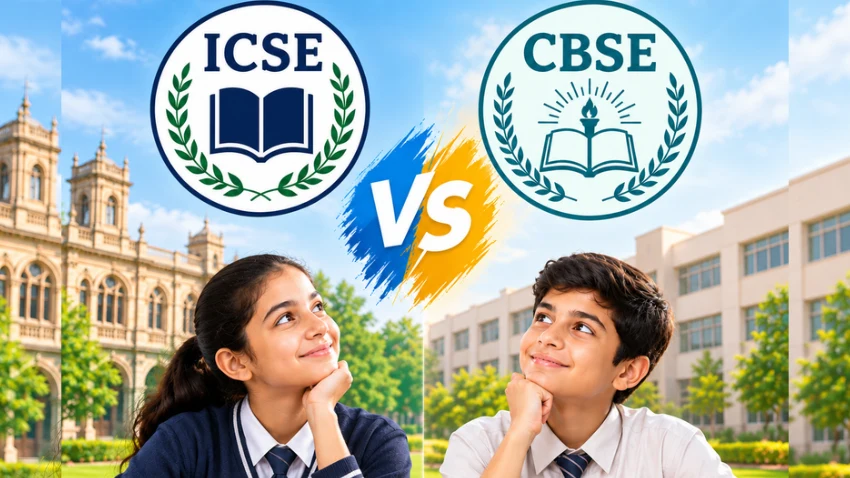
CBSE vs ICSE: Key Differences
The debate between ICSE vs CBSE is never-ending. However, to choose the right board, parents need to evaluate subject choices, assessment methods, and curriculum structures. Here is a closer look at the key differences between the two:
| Basis | CBSE | ICSE |
| Full form | Central Board of Secondary Education | Indian Certificate of Secondary Education |
| Governing body | CBSE | CISCE |
| Class 10 examination | CBSE board examination | ICSE board examination |
| Main curriculum | Structured curriculum with NCERT-based learning widely used | General education with a detailed subject syllabus |
| English | English language and literature options | English is compulsory |
| Compulsory subjects in Class 10 | Two languages, Mathematics, Science, and Social Science under the standard scheme | English, a second language, and History, Civics and Geography |
| Subject selection | Includes academic and skill-based options | Includes academic, applied, and vocational options |
| Class 10 subject assessment | Subject-wise theory and internal assessment rules apply | Group I and II subjects generally use 80% external examination and 20% internal assessment |
| Practical or internal work | Depends on the subject and curriculum guidelines | Some Group III subjects use 50% external examination and 50% internal assessment |
| Learning approach | Structured subject learning, with skill and interdisciplinary options | Detailed subject coverage with written and practical work |
| Competitive exam preparation | Often convenient for students following NCERT-based entrance exam preparation | Also supports higher education; students may need to align preparation with entrance exam syllabi |
| Changing schools | A useful option for families who move between cities | Also transferable, but the availability of a suitable affiliated school matters |
| Best suited for | Students who prefer a structured curriculum and possible future mobility | Students who enjoy detailed learning, English, and varied subject options |



When to Choose CBSE?
CBSE can be an ideal option for students looking for a systematic syllabus, clear subject options, and preparation for competitive exams. Many parents choose CBSE schools in Dehradun and beyond for their students’ academic as well as holistic growth.
- Competitive Exams: Opt for CBSE if your child wishes to use NCERT-based study resources to prepare for the NEET or JEE exams.
- Moving Frequently: Enrollment in CBSE can ease school shifting whenever parents change locations, thanks to its wide network of schools.
- Systematic Learning: Its structured syllabus provides students with the theme of well-organized learning goals for different subjects.
- Science and Mathematics: CBSE boarding schools in Dehradun provide structured education for those wanting to pursue Engineering, Mathematics, or any technological specialization.
- Skill Enhancement Opportunities: Students can also take up additional subjects like Vocational Studies or Information Technology in CBSE schools.
When to Choose ICSE?
Students who prefer studying topics in-depth, possess English communication skills, and enjoy a mix of academic and practical tasks may benefit from the ICSE program.
- Proficiency in English: If students want to strengthen their reading, writing, and overall English skills, then the ICSE program is suitable for them.
- In-Depth Study: Students who enjoy studying topics in-depth will benefit from the syllabi offered in ICSE.
- Practical Evaluation: Internal assessment is part of various subjects, which allows students to showcase their knowledge and skills through practical work.
- Variety of Subjects: The ICSE program is rich in subjects such as Computer Applications, Art, Environmental Applications, and Performing Arts.
- Balanced Education: The balance of academic subjects and activities in ICSE schools appeals to students with a wide range of interests.
Conclusion
The decision of CBSE vs ICSE should be based on what your child actually needs. Parents need to consider their child’s learning aptitude, interests, and future goals to make a wise decision. Children receive a standard education on both boards, so parents will have to assess the quality of education, the types of subjects taught, and even the facilities offered in a school.
If you are looking for schools in Dehradun for your child, there are many options available in both CBSE and ICSE formats. Consider the reputation of the school, its years of operation, previous years’ results, and overall adherence to students’ holistic growth. Thus, you will be able to find a good board for your child’s educational and personal growth.
Also Read – 10 Moral Values for Students That Build Character and Success