CBSE vs CAIE: Understanding the Key Differences
CBSE and CAIE are two different board systems. CBSE is an Indian board that offers structured learning and supports competitive exam preparation. CAIE is an international curriculum that focuses on critical thinking and practical learning. The two systems have different subjects, exams, teaching styles, and levels of flexibility.
CBSE and CAIE may both be school education systems, but they do not follow the same approach. CBSE follows an Indian education system, while the CAIE board brings a more international approach to learning. They differ in subjects, exams, teaching methods, and subject choices. So, if you are trying to choose the right curriculum for your child, understanding these differences makes the CBSE vs CAIE comparison much easier.
What Is the CBSE Board?
The Central Board of Secondary Education (CBSE) is a national education board in India. It works under the Ministry of Education, Government of India, and many public and private schools follow it. CBSE prepares the school syllabus, gives schools approval, and conducts Class 10 and Class 12 board exams. Schools mainly use NCERT books and follow the CBSE learning pattern.
What Is the CAIE Board?
The CAIE board stands for Cambridge Assessment International Education. It is an international education system that is part of the University of Cambridge. Many schools around the world follow this system. CAIE focuses on helping students understand what they learn, think for themselves, and use their knowledge in real-life situations. It also gives students many subjects to choose from based on their interests.
CBSE vs. CAIE: Head-to-Head Comparison
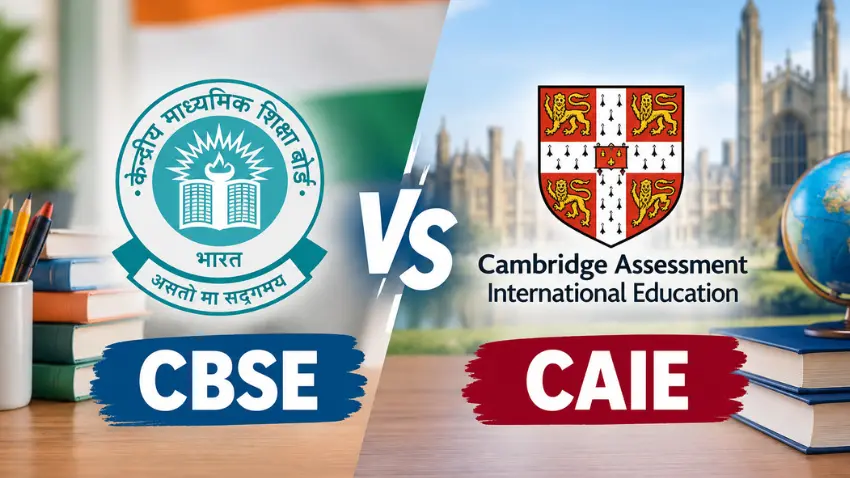
The Cambridge vs CBSE comparison is easier when you look at their main differences together. The table below gives a simple look at their subjects, teaching style, exams, fees, and other key points.
| Point | CBSE | CAIE |
| Education System | Indian education system. | International education system. |
| Curriculum Structure | More structured and follows a set syllabus. | More flexible with a wider choice of subjects. |
| Teaching Method | Focuses on concepts, textbooks, and regular practice. | Focuses on understanding, practical learning, and critical thinking. |
| Subject Choice | Subject options are generally more limited. | Offers a wider range of subjects. |
| Exams | Includes Class 10 and Class 12 board exams. | Includes IGCSE and AS and A-level exams. |
| Assessment | Includes exams, school tests, and practical work. | Uses exams, coursework, and practical assessments depending on the subject. |
| Competitive Exams | Well suited to students preparing for Indian entrance exams. | Provides a different approach and may need extra preparation for some Indian entrance exams. |
| Recognition | Widely recognized in India and accepted by universities abroad. | Widely recognized by schools and universities around the world. |
| Fees | Usually more affordable, with many school options. | Fees are often higher than CBSE schools. |
| Availability | Many CBSE schools are available across India. | CAIE schools are fewer compared with CBSE schools. |
| Learning Style | Good for students who prefer a clear and organized study pattern. | Good for students who enjoy independent and practical learning. |
| Best For | Students planning to study mainly in India. | Students interested in international education or studying abroad. |
Advantages of Choosing CBSE
Choosing CBSE gives students a clear and organized way to study. Its common syllabus also makes it easier for students to change schools if their family moves to another city. CBSE also gives students a good base for competitive exams and focuses on understanding subjects instead of only memorizing answers.
Key Advantages of CBSE
- Same Syllabus: Most CBSE schools follow the same syllabus, so students may find it easier to change schools after moving to another city.
- Competitive Exams: The CBSE study pattern gives students a good base for exams like JEE, NEET, and CUET.
- Clear Learning: CBSE focuses on helping students understand their subjects instead of only learning answers.
- Easy to Find: CBSE schools are available in many cities and towns across India, which gives families more school options.
- Good Recognition: Many colleges and universities in India and other countries accept CBSE.
- Overall Development: CBSE schools also encourage students to take part in sports, arts, and other activities along with their studies.



Advantages of Choosing CAIE
The CAIE board gives students an international way of learning. It helps them understand their lessons, think about what they learn, and use their knowledge in everyday life.
Key Advantages of CAIE
- Global Recognition: CAIE certificates are accepted by many schools and universities in different countries. This is helpful for students who may want to study abroad later.
- Better Understanding: Students learn to understand a topic instead of only memorizing answers. This helps them remember and use what they learn.
- More Subject Choices: Students get many subjects to choose from based on their interests. This gives them more freedom to study subjects they enjoy.
- Useful Skills: Students develop skills like teamwork, communication, research, and problem-solving. These skills also help them outside the classroom.
- Practical Learning: Students learn through activities, projects, discussions, and real-life examples. This helps students understand lessons better and enjoy learning.
Parents looking for a school that offers both CBSE and CAIE options can consider boarding schools in Dehradun. These schools offer both education systems, which gives parents more choices based on their child’s learning style and future plans.
How to Choose: Which Board Fits Your Child?
There is no one board that is best for every child. The right choice depends on how your child likes to learn, what they want to do later, and what works for your family.
- Think About How Your Child Learns: Every child learns in their own way. If your child likes a clear study plan and regular practice, CBSE may be a good choice. However, if they enjoy practical work, asking questions, and learning by doing things, CAIE may suit them better.
- Think About Future Plans: It is also good to think about what your child wants to do after school. CBSE is helpful for students who plan to take Indian entrance exams. The CAIE board is a good choice for students who want to study in another country.
- Think About Moving to Another City: If your family may move to another city, CBSE may be easier to continue because many schools follow the CBSE system. So, keep this point in mind when choosing a school.
- Check the School Fees: School fees also matter. That is why check the full cost of the school, including books, activities, transport, and other charges. Then choose a school that fits your family’s budget.
- Check the Subjects: Think about the subjects your child likes. CAIE gives students many subjects to choose from, while CBSE follows a more fixed study pattern. So, choose the board that offers the subjects your child needs.
- Look at the School: The board is not the only thing that matters. Also check the teachers, teaching style, school facilities, activities, and the school environment. A good school should make your child feel comfortable and supported.
- Think About Your Child: Most importantly, think about what is best for your child. The right school should help them understand their lessons, enjoy learning, and feel confident as they grow.
Conclusion
CBSE and CAIE board both give students good learning opportunities, but they follow different ways of teaching. CBSE gives a more structured study pattern, while CAIE gives more focus to practical learning and independent thinking. So, parents should choose the board based on their child’s needs, interests, and future plans.
Parents who are looking for the right school can consider schools in Dehradun. These schools offer both CBSE and CAIE options along with large classrooms, advanced science and computer labs, playgrounds, hostel facilities, friendly staff, and a safe learning environment. These facilities give students a comfortable place to study, play, and grow.
FAQs
1. Is CAIE better than CBSE?
Both boards are good, but they are different. CBSE is good for students who like a fixed study pattern and want to prepare for Indian entrance exams. CAIE is good for students who enjoy practical learning or want to study abroad.
2. Is Cambridge Board more difficult than CBSE?
Not always. Both boards teach and test students in different ways. CAIE board may feel different because students need to understand topics and use what they learn.
3. What are the disadvantages of the Cambridge curriculum?
CAIE schools may have higher fees and fewer school choices in some places. Students may also need time to get used to the subjects and exams.
4. Is there a difference between CAIE and CIE?
Yes, CIE was the old name used for Cambridge International exams. CAIE is the name used today for Cambridge Assessment International Education.
5. Which board has more subject choices?
CAIE usually offers more subjects to choose from. Students can pick subjects that match their interests and future plans.
Also Read – Types of Boarding Schools in India: A Guide to Indian Boarding Schools